The Assistant Chose the Wrong Tool Before It Gave the Wrong Answer
Ask for a list of projects and the assistant had two near-identical ways to get one. The wrong answer started there, before any result logic ran.
A user asks the assistant for a list of projects. It’s about as plain as a request gets.
Behind that sentence, the assistant is staring at two tools that both claim the job. Two parts of the assistant each carried their own copy of the project list, same purpose, slightly different homes. Which copy got picked could change from one ask to the next, and sometimes the pick was simply wrong.
Here’s the shape of it, paraphrased and simplified. This is the kind of answer you get when the question lands on the wrong side:
Give me a list of my projects.
I don’t have a way to list projects from here. That may be handled somewhere else in the product.
The tempting move is to call this a routing problem. Reword the instructions, nudge the assistant toward the right copy, retest. I get the appeal. The symptom looks like a wrong answer, and we usually fix wrong answers with words. But words can’t remove an ambiguity that the software keeps offering. If two choices describe the same job, the assistant has to invent a difference between them that the product never meant.
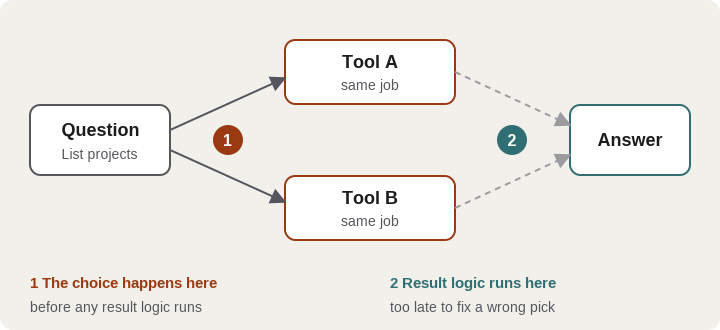
That changed the question I wanted a test to answer. It wasn’t only “does the list look right?” anymore. It was “why was the assistant ever asked to choose?”
The story we wrote down said three things. Current behavior: two overlapping copies, and selection that varies. Expected behavior: one shared project-list tool, where intent and context decide how it’s used, not which copy exists. Out of scope: rebuilding how the results themselves are produced, because the results weren’t the problem.
That shape was familiar. On the mobile apps I’d filed product changes as stories from what QA found: what happens now, what should happen, and where the change stops.
A final answer is the last visible event in a chain of decisions.
This is where testing has to move upstream. A final answer is the last visible event in a chain of decisions. If the assistant picks the wrong tool, every later check can pass against the wrong job. The request is well formed. The result matches the tool that ran. The response is polished. The user’s intent got lost at the first fork.
Overlap also makes the expected result hard to state. If two routes both look valid from their descriptions, which one does a test call correct? Pin whichever happened to win first and you’ve frozen an accident. Accept either and you’ve blessed the inconsistency.
Later, a batch of routing checks went red, and they weren’t one kind of failure. Some expectations were stale. Some hit limits in how the test setup could walk a conversation one step at a time. Some were real gaps in behavior. A single broad instruction would have fixed none of them cleanly, so each got a fix at the place where its assumption broke.
Natural-language filters taught me the same lesson from a different angle. A user can ask for one filter, two at once, a phrase that could mean two values, or something the product doesn’t filter on at all. The test plan followed the words through extraction, mapping, the request built from them, combinations, ambiguity, and the final result. It never said “make the assistant understand filters.” It listed every place the product had to decide something. Which fields are supported? How does a phrase map to one? What happens when a value could mean two things? What happens when the request asks for something outside the set?
Those two problems look unrelated, but they push the same way. The assistant does better when the choices the software offers match decisions someone can explain. If two choices are accidental duplicates, remove one. If they’re truly different, make the difference visible and testable.
Consolidating doesn’t make every request identical. Intent and context can still change how the one tool behaves. It just means the assistant no longer has to guess at a distinction that doesn’t help the person asking.
It doesn’t make language deterministic either. The assistant can still read a request in more than one way. What changes is the menu, and a test can finally check whether the chosen action matches the stated intent instead of trying to work out which duplicate happened to win.
I’d test the shared design from both sides. Several phrasings of the same intent should reach the same tool. Requests with different intent should still separate where the product says they should. Context can refine a request, but it shouldn’t bring the duplicate back through the side door. An ambiguous phrase should get the product’s declared ambiguity behavior, not whichever route fired first. An unsupported one shouldn’t look handled just because something came back.
Keeping the change small matters too. A routing symptom tempts you to touch prompts, descriptions, formatting, and queries all at once. Then a passing retest can’t tell you which edit removed the ambiguity. A narrow change gives you one promise to protect, and one decision to revisit if something breaks.
The test still has to reach the answer the user sees, because a correct selection that produces an unusable result isn’t success. But separating the two lets each failure speak for itself. Did ordinary wording reach the intended tool? Did the request keep its context? Did the answer give the user a list without drifting into some other task?
Once the responsibility is clear, a test can hold the wording steady, check the selection, and follow the result. If the result is wrong, the failure started later. A result bug gets debugged as a result bug. A wording bug gets reviewed as a wording bug. One product decision took a whole branch of uncertainty out of every investigation that came after it.
So before I touch a sentence of the assistant’s instructions, I look at what we’ve put on its menu. Here, the fix was deleting one of two identical items.
The next question was harder. When the right tool runs and every row it returns is correct, can the sentence the assistant wraps around those rows still be false?