My First AI Test Plan Was Four Unchecked Questions
Search, selection, near matches, memory: four questions about one tool, and not a single box checked.
Four boxes sat unchecked.
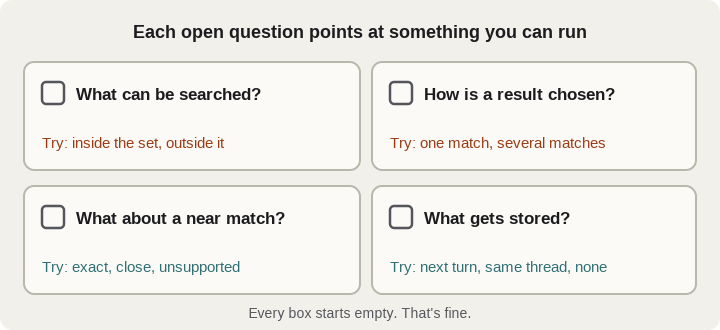
They asked what a tool could search, how it selected a result, what happened with a near match, and whether it stored anything. A second page from the same early period held a single line about another group of tools. That was my visible starting point on the AI assistant: questions first, very few settled answers.
My earlier work had been mobile QA. I’d spent about a year and a half running QA for two apps, with more than a thousand test cases behind me. I knew how to shorten a reproduction path, compare actual and expected behavior, vary field order, and check whether a value survived navigation. The assistant was a different surface. A request could be interpreted, routed, transformed, and answered through several steps that weren’t visible on one screen.
The move didn’t happen in one clean scene. Mobile regression carried on after AI-specific stories had begun.
The unchecked boxes weren’t proof that I knew nothing. They showed where my existing habits met a system I couldn’t yet describe.
The first question, what can be searched, is a scope question. A user can type almost anything into an assistant, but the capability behind the response usually accepts something narrower. Before testing the answer, I needed to know what the thing was meant to find.
The second question, how a result is selected, turns a vague idea into cases you can observe. What happens with one clear match? With several possible matches? Does the system choose, ask, or return a set? You don’t need to know the implementation to see that those are different expected behaviors.
The third question was about near matches. In a mobile form I might vary capitalization, spacing, length, or order. In a language-driven interface I could vary the wording and see whether two phrases that should mean the same thing reached the same capability. The question didn’t assume they must. It made the uncertainty testable.
Here’s the kind of exchange I mean. This one is made up and paraphrased, but it shows how many things “near” can lead to.
Show me the active projects in the west region.
I couldn’t find a region called “west.” Did you mean “Western”?
Is asking the right move? Or should it have quietly picked the closest value, or returned nothing? That’s a product decision. Until someone makes it, the assertion stays blank.
The last question, whether anything was stored, brought me back to persistence. Mobile testing had taught me that the value on the current screen might disagree with the value after leaving and returning. In a conversation, state might affect the next request, the current thread, or nothing at all. I had to learn which behavior was intended before I could call a difference a defect.
An open question is useful only if it can become an observation. “How does matching work?” is too broad to run. “What happens when the request contains an exact value, a close value, an ambiguous value, or an unsupported value?” gives you cases. It also gives you a place to write down that the expected behavior is still unknown.
That last part matters. Unknown behavior should stay visibly unknown until someone clarifies it. A blank assertion is more honest than a confident guess disguised as a test.
A later checklist in my work used the same shape for natural-language filtering. The request had to move through extraction, value mapping, request construction, combined filters, unsupported fields, ambiguous values, and the final result. Instead of treating the last answer as the only checkpoint, the plan followed meaning through every step that could change it.
It looks far from four empty boxes, but the structure is the same. Ask what goes in. Ask how it’s interpreted. Ask what the system chooses. Ask what survives into the next step. Ask what the user finally sees.
A blank assertion is more honest than a confident guess disguised as a test.
This matters when the answer sounds fluent. A mobile screen with a missing icon gives you something to point at. A polished sentence can hide where the wrong choice happened. If I test only the final wording, I may know the answer is wrong without knowing whether the request was extracted badly, mapped to the wrong value, sent incorrectly, or rendered incompletely.
The checklist keeps those possibilities apart. It also avoids a case that depends on one lucky response. Some parts of an assistant vary. Other parts, like a typed input, a constructed request, or a stored fixture, should be steady enough to check directly.
Soon the questions began turning into code. First came a handful of tests, then a broader batch covering requests, errors, response shapes, configuration, and lifecycle cases. Local stand-ins and parameterized checks made the setup repeatable.
There’s a useful humility in leaving a box unchecked. It says the expected result hasn’t been earned yet. A tester can do damage by turning a guess into an assertion and then making the product satisfy it. In a new domain, the first job is to separate what the system promises from what I happen to assume.
I can still make progress while the answer is open. I can list the inputs that need clarifying, prepare fixtures, mark the visible checkpoints, and write down competing expected behaviors. If selection might choose automatically or ask the user, I can describe both and wait for the product decision. That beats silently picking one and later treating the other as a regression.
The questions get sharper as I learn. “Does it remember?” becomes “Which state should affect the next request, and when should it be cleared?” “Does search work?” becomes “Which values are supported, and what should happen when several results are equally plausible?” Better questions are already part of the test design, before the final assertion exists.
I can also mark which layer each question belongs to. Search scope is a product promise. Selection may mix language behavior with fixed routing rules. Storage is ordinary software state. A near match may need a product decision before it needs an assertion. Sorting them this way keeps me from asking a variable interaction to prove a storage guarantee, or asking a unit test to prove how ordinary language will always be read.
That habit stayed with me when failing cases later needed diagnosis. Some came from expectations that no longer matched intended behavior. Some came from limits in the setup. Others exposed real gaps. Treating all three as product failures would have made the tests louder and less accurate.
The four questions didn’t resolve any of that. They gave me a safe place to begin, and each one pointed at a case I could eventually run, a behavior I could clarify, and a check I could write.
There was no ceremony when that began. It happened when the questions changed form, from lines on a page into requests, fixtures, local stand-ins, and tests that could turn red.